



OFFICE OF THE RESEARCH AND DEVELOPMENT SERVICES
VISION:
A strong and dynamic research culture supportive to the generation and transfer of knowledge ensuring sustainable national development.
MISSION:
Support and sustain Research & Development programs catered to the total upliftment of life at the NwSSU service areas.
OBJECTIVES:
- Enhance the research capabilities of the members of the academic community;
- Improve research productivity in distinctive areas of competence;
- Generate and provide knowledge/technologies and maintain research and development data bank of relevant information;
- Establish and strengthen linkages and share research resources and technologies between and among concerned agencies; and
- Promote and facilitate dissemination and utilization of R & D outputs.
RESEARCH THRUSTS AND PRIORITIES:
The research thrusts and priorities of the University are in consonance with the institutional, regional, and national concerns. It promotes the National Higher Education Research Agenda (NHERA) set forth by the Commission on Higher Education (CHED). It is complemented by the University’s advocacy for relevant and quality education and lifelong learning. The following are the research priorities and thrusts of the University:
National Higher Education Research Agenda (NHERA)
- Priority Discipline Clusters that focuses on science and mathematics, education and teacher training, health and health profession, information and communication technology, engineering, maritime and architecture, agriculture, environmental science, humanities, social sciences, and other disciplines as identified by the Commission of Higher Education.
- National Science and Technology Plan (NSTP) that prioritizes on S&T area thrusts on agriculture, forestry and natural resources, health and medical sciences, biotechnology, information and communication technology, microelectronics, earth and marine sciences, fisheries and aquaculture, environment, natural disaster mitigation, energy, materials science and engineering, and manufacturing and process engineering.
- National Integrated Basic Research Agenda (NIBRA) that prioritizes on policy, government, education and international affairs, social sciences and the humanities.
- National Unified Health Research Agenda (NUHRA) that focuses on major areas of health financing, governance, health regulations, health service delivery, health technology development, health research ethics, and health information system.
- Recommendations of the Congressional Commission on Science and Technology and Engineering (COMSTE) that focus on agriculture and food, electronics and semi-conductors, energy and environment, health sciences, IT and IT-related industries, and science, mathematics and engineering education.
- Multidisciplinary/Multisectoral Research that focuses on food safety and security, enhancing indigenous renewable energy source in the domestic energy mix, development of vaccines and diagnostic kits using indigenous materials, disaster risk management, pollution control, climate change and global warming, future ASEAN, peace process and conflict resolution.
Harmonized National Research and Development Agenda (HNRDA)
- National Integrated Basic Research Agenda (NIBRA) that focuses on water security, food and nutrition security, health sufficiency, clean energy, sustainable communities, and inclusive nation-building.
- Health that focuses on drug discovery and development, diagnostics, functional foods, hospital equipment and biomedical devices, information and communication technology for health, dengue, nutrition and food safety, disaster risk reduction on health, climate change adaptation on health and omic technologies for health.
- Agriculture, Aquatic and Natural Resources Sector (AANR) that focuses on agricultural crops and livestock, fisheries and aquaculture, forestry, natural resources and environment, technology transfer, and socio-economics and policy research.
- Industry, Energy and Emerging Technology that focuses on food and nutrition security, countryside development, competitive industries, delivery of social services, intelligent transportation solutions, renewable energy and energy storage solutions, and human security.
- Disaster Risk Reduction and Climate Change Adaptation (DRR-CCA) that focuses on observation and monitoring networks, technology development and application for monitoring, modelling and simulation for improvement of monitoring and forecasting, hazard, vulnerability and risk assessment, warning and risk communication, technology development and application for climate change mitigation and adaptation, technology development for disaster risk management, and policy research.
Eastern Visayas Research and Development Agenda (EVRDA)
- Health Research that focuses on health services, communicable diseases, maternal and child health care, health technology development, health care financing, health governance, health knowledge management, environmental health, lifestyle diseases, DRRM and CCA in health, health infrastructure, traditional and alternative health medicine, health promotion, health regulation, drug and substance abuse, drug discovery and diagnostic kits.
- Agriculture, Aquatic, and Natural Resources (AANR) that focuses on priority commodities in agriculture, priority commodities in aquatic resources, priority commodities in environment and natural resources, food security, ecosystem stability, DRRM-CCA in AANR, potential emerging crops, livestock, fisheries, and technologies, and productivity and profitability studies.
- Industry, Energy, and Emerging Technology that focuses on food and nutrition security, countryside development, competitive industries, delivery of social services, renewable energy and energy storage solutions, and human security.
- Basic Research that focuses on biodiversity conservation, water governance, harmful algal blooms, and the development of an automated environmental monitoring tool.
- Cultural Heritage that focuses on environment, history, and culture.
- Poverty and Sustainable Development that focuses on literacy, teaching enhancement for senior high school, and other relevant extension and public service initiatives.
- DRRM-CCA Research that focuses on the adoption of automated weather monitoring system in support to agri-extension, design and development of resilient housing, and protected cropping, to reduce vulnerability of individuals, and disaster-resilient communities.
- Tourism Related Researches that focus on agriculture tourism, community tourism, ecotourism, and others.
UNIVERSITY RESEARCH PROCESS:
CALL FOR PROPOSALS
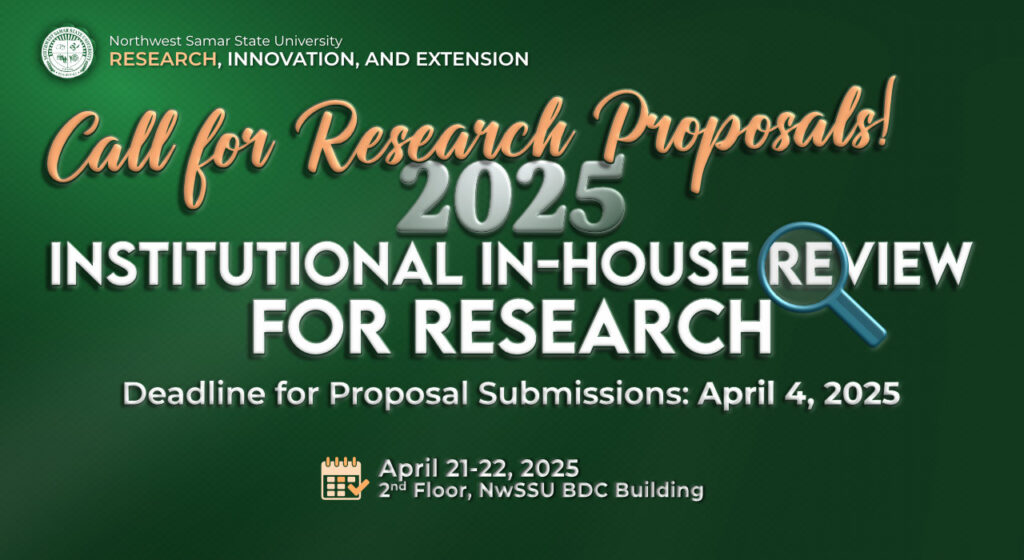
A call for papers will be announced specifying the date of submission and deliberation of research proposals for In-House Review. Research proposals submitted beyond the prescribed deadline set by the ORDS shall be considered for deliberation in the next In-House Review.
COLLEGE RESEARCH COORDINATORS FACILITATE THE SUBMISSION OF PROPOSALS
The research coordinator and the College Dean where they are stationed shall endorse the proposal for submission to the ORDS using the prescribed format. The R&D Director will convene the research panel for an In-House Review to evaluate the merit of the proposal.
IN-HOUSE REVIEW AND EVALUATION
The papers will be evaluated by a panel of evaluators following a criteria.
The research projects will be prioritized based on the following criteria:
(1.) It is within the priority areas listed in the University Research Agenda, Thrusts, and Priorities.
(2.) The project implementers can carry out the program/project.
(3.) There is urgency and importance of the research output.
(4.) The project practicability of the timetable and budget not greater than P100,000.00 (for university-funded projects).
The proposal shall be revised based on the panel's evaluation and comments before implementation.
The following documents should be secured before the implementation of the project:
Special Order
Notice to Proceed
Memorandum of Agreement
IMPLEMENTATION OF RESEARCH PROJECTS
The research project implementers shall conduct their research within the specified duration of the project. The implementers shall ensure proper documentation and records of their projects.
MONITORING AND EVALUATION
The Monitoring and Evaluation shall be done before, during, and after implementation. There should be a monthly report if the approved project has 6 months of duration A quarterly report is required if the approved project duration is 12 months or more than 1 year. The project implementers should use the prescribed format for the monthly/quarterly reports, and catch-up plan.
POST PROJECT REPORT AND REVIEW
After the implementation of the project, the researchers are required to submit a Terminal Report with the College Dean's Endorsement through the College Research Coordinator.
UNIVERSITY RESEARCH CENTERS:
Center of Research for Future Building Materials and Structures
Samar Integrated Organic Agriculture Research and Development Center (SIOARDC)
Data Analytics Center (DAC)
Research Center for Local Governance (RCLG)
TEMPLATES AND FORMS:
(click on the title of template/form to access it)
THE ORDS TEAM

JOSEPH EMIL A. DAVID
ORDS Director

Ian D. Becoñado
University Statistician

ROLLY L. ORTIZ, PH.D.
Administrator, Research Publication Website

RHEA JENNY A. OGALESCO
Research Communication Specialist

PRECIOUS JOYCE D. OGDOC
University Researcher for Social Sciences

FELIX JOHN M. REFAMONTE
University Researcher for Science and Technology

RENALYN F. CACA
Office Secretary