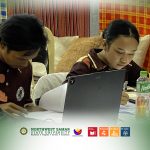
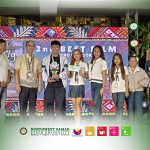
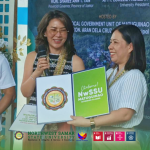
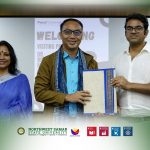
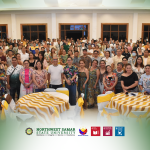
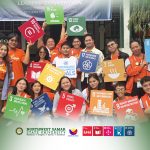
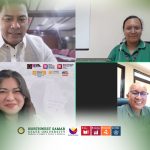
Northwest Samar State University (NwSSU) brought its teaching and non-teaching staff together for a three-day In-Service Training from September 9 to 11, 2026, at Villa Cruz Resort, San Roque, Northern Samar. The training opened with a GCash orientation led by Mr. Amed Macabit, who introduced the platform’s features for faster, easier, safer, and cashless transactions for university services and personal errands. He shared that NwSSU is now one of the first State Universities and Colleges (SUCs) in Region 8, along with Eastern Visayas State University (EVSU), to partner with GCash, in line with the government’s vision to build a more digital Philippine nation under Executive Order 170. Mr. Macabit noted that the University’s own GCash QR code will be launched soon, enabling students to pay for services through GCash and supporting the disbursement of student subsidies, scholarship allowances, and personnel funds through an NwSSU institutional wallet with real-time reporting and monitoring. NwSSU constituents will also receive a free GCash card once launched. University President Atty. Lorelie Fabillar-Tangaran, DM, delivered a message and institutional updates centered on the “N” in the University’s ASCEND Framework — nurturing human resources. She emphasized the need to upskill in the age of AI to provide better, transformative, and globally competitive education, noting that competitiveness also means being relevant and responsive. She underscored that AI should be treated as a tool, not a replacement, calling for assessments and methods to be realigned to develop students’ critical thinking, alongside policies and guidelines that evolve with the times. She announced that the University’s new vision and mission statements will be launched soon, geared toward digital transformation — beginning with an assessment of processes that could be digitalized or automated, the establishment of a centralized digital platform, and updates to university manuals and the university code. She also called for stronger safety and security measures through preventive and proactive steps, guided by the ASCEND and ACHIEVE frameworks, and asked for the community’s support in performing their duties toward the University’s institutional targets. Dr. Teodoro A. Amatosa, Jr., Vice President for RIEEA, presented the Source-to-Sea Framework, anchored on NwSSU’s geographic and academic mandate along the ecological continuum of Samar, with focus areas in agriculture, forestry, natural resources, maritime affairs, fisheries, and advanced technologies. He identified gaps in infrastructure, leadership, and siloed academic operations, and outlined plans to streamline internal procurement systems, activate grant support and mentoring mechanisms, and create incentives for research productivity, envisioning NwSSU as a Research-Led University delivering on its mandate of Resilience, Integrity, Service, and Excellence. He also introduced the Triple Helix Ecosystem as the University’s guiding model for innovation and development programs, with NwSSU set to develop its own research and extension agenda harmonized with stakeholders and national R&D frameworks. Dr. Archie B. Lauderes, Director of Extension Services, discussed the DBM Joint Circular guidelines on faculty reclassification, common areas where faculty applications fall short, and ways to address them moving forward, alongside updated procedures under the revised Extension Manual. Mr. LJ A. Magnaye, Director of Research Services, guided participants on structuring research papers for publication, from establishing a clear research gap to presenting a solution, emphasizing clarity and simplicity over jargon. He also shared how AI tools can support research writing, literature review, and presentation, and walked participants through selecting appropriate journals based on scope, reach, indexing, metrics, article processing charges, peer review process, and turnaround and acceptance rates. He cautioned participants against predatory journals, citing red flags such as unusually rapid reviews or acceptance rates, hidden fees, fabricated editorial boards, and clone journals that falsely use the logos and names of legitimate organizations. Day 2 highlighted a keynote lecture on artificial intelligence in education, “From Prompt to Pedagogy: AI-Enabled Teaching, Learning & Assessment for the Future – Ready Educator,” delivered by resource speaker Dr. Las Johansen Caluza. The afternoon session covered key policy and compliance topics, including a talk on nihilistic violent extremism by PLtCol. Alden E. Dugan, the University’s gambling prohibition policy, an orientation on student off-campus requirements, and international travel guidelines, alongside updates on quality assurance and procurement processes for SUCs. The training concluded on September 11 with team building activities for the NwSSU teaching and non-teaching staff, capping a program designed to strengthen the knowledge, skills, and institutional alignment of the University’s workforce as NwSSU continues to advance its commitment to service, integrity, and excellence. For more photos, view the full album here: https://drive.google.com/drive/folders/183EDbCmAGwXA4gNZ66bNb46kXNs2r9pt?usp=sharing