Menu


Post Views: 19
2.2 Campus Food Waste
2.2.1 – Campus food waste tracking
2.2.2.1 – Total food waste
2.2.2.2. – Campus population
Northwest Samar State University is keenly aware of the environmental impact of food waste and has taken several steps to address this issue. With a student population that fluctuates around 6,000 to 8,000, (see Table 1 Historical Population) and over 500 staff members (see Table 2 Employees Population), the potential for significant food waste is substantial. The university has introduced various measures to minimize food waste across its campus.
2.3 Student Hunger
2.3.1 – Student food insecurity and hunger
“The Bachelor of Science in Food Technology proudly concluded their first-ever Educational tour in Cebu City held last October 22–24, 2025, with the participation of both third-year and fourth-year students. Accompanied by their Program Chair Mrs. Maria Norfrelij Juanillo and faculty members Ms. Maria Joana Nicolas and Mr. Jerwin Mabilangan, the tour served as a valuable opportunity for experiential learning and professional growth.
During the three-day tour, students visited various food manufacturing and processing facilities where they gained insights into food safety practices, quality control, production processes, and technological innovations shaping the modern food industry.”
𝗕𝗮𝗰𝗵𝗲𝗹𝗼𝗿 𝗼𝗳 𝗦𝗰𝗶𝗲𝗻𝗰𝗲 𝗶𝗻 𝗙𝗼𝗼𝗱 𝗧𝗲𝗰𝗵𝗻𝗼𝗹𝗼𝗴𝘆 (𝗕𝗦𝗙𝗧) program of Northwest Samar State University proudly showcased the brilliance of its students during 𝐓𝐚𝐬𝐭𝐞 𝐐𝐮𝐞𝐬𝐭: 𝐀 𝐅𝐢𝐞𝐬𝐭𝐚 𝐨𝐟 𝐅𝐨𝐨𝐝 𝐈𝐧𝐧𝐨𝐯𝐚𝐭𝐢𝐨𝐧, held at the Food Processing Area. The event was more than just a food exhibit, it was a celebration of science, creativity, and purpose, where student innovators brought to life exciting new food concepts focused on health, nutrition, and sustainability.
The initiative aimed to support evacuees in the campus victimized by the devastating Super Typhoon Uwan, alongside dedicated responders and volunteers who tirelessly aided affected individuals.
NwSSU staff lined up for free snacks and refreshments, served in celebration of Cong. Reynolds Michael T. Tan’s birthday. The surprise treat added flavor to the day, giving the NwSSU community a quick break and a shared moment of delight.
Showcasing their growing competency in clinical judgment and diet therapy application, the Bachelor of Science in Nursing (BSN) Level II Section A students presented their case analyses in NCM 105: Nutrition and Diet Therapy on December 9, 2025. Under the supervision of their course instructor, Ms. Maria Joana T. Nicolas, and evaluated by a panel composed of College Dean Dr. Bianca Genel B. Bedio and clinical instructors Mrs. Rosilda D. Macapanas, Mr. Carl Neill M. Del Rosario, and Mr. Charles Daryll A. Delmo, students delivered comprehensive presentations on key nutritional concerns.
The Level-II BS Nursing students completed their NCM 105: Nutrition and Diet Therapy laboratory session on November 26, 2025, under the supervision of Ms. Maria Joana T. Nicolas, RND, PFT. This hands-on activity guided studentd in prepearin home-based osteorized feeding which is an essential intervention for patients unable to eat normally.
The Level-II BS Nursing students completed their laboratory “Care on Nutrition (CON) Across the Life Stages” is conducted as part of the Nutrition and Diet Therapy course.
The NwSSU Student Hunger Interventions is a university-led initiative aimed at addressing food insecurity within the Northwest Samar State University (NwSSU) community. The program provides support to students and staff experiencing hunger through food assistance drives, meal programs, and sustainable solutions such as campus gardens and food-sharing projects. It promotes compassion, wellness, and community engagement, ensuring that no member of NwSSU goes hungry while fostering a culture of care and mutual support.
Highlighting their dedication to promoting preventive health and community empowerment, the Bachelor of Science in Nursing (BSN) Level-II students carried out the Pasiguro Komunidad 2025 Community Health Nursing Culminating Program on November 29, 2025, at Basud Integrated School in Brgy. Basud, Calbayog City, Samar, anchored on the theme “Alta Presyon Bantayan, Libong Dire Pasagdan.” The event featured a series of interactive and service-oriented activities including free blood pressure screening, informative lectures on hypertension and dengue, an energizing Zumba session, free food distribution, and an exciting raffle draw, which are designed to raise health awareness and encourage active community participation.
2.3.3 – Sustainable food choices on campus
As outlined in the Philippine Development Plan on Nutrition, it is crucial to ensure the availability of safe, affordable, and nutritous food for all Filipinos.
2.3.4 – Healthy and affordable food choices
As outlined in the Philippine Development Plan on Nutrition, it is crucial to ensure the availability of safe, affordable, and nutritous food for all Filipinos.
2.3.5 – Staff hunger interventions
The NwSSU Staff Hunger Interventions is a university-led initiative aimed at addressing food insecurity within the Northwest Samar State University (NwSSU) community. The program provides support to students and staff experiencing hunger through food assistance drives, meal programs, and sustainable solutions such as campus gardens and food-sharing projects. It promotes compassion, wellness, and community engagement, ensuring that no member of NwSSU goes hungry while fostering a culture of care and mutual support.
2.4 Proportion of graduates in agriculture and aquaculture including sustainability aspects
2.4.1 – Number of graduates
977
2.4.2 – Number of graduates from agriculture and aquaculture courses including sustainability aspects
37
2.5 National Hunger
2.5.1 – Access to food security knowledge
Our university is devoted to enhancing food security and promoting sustainable agriculture and aquaculture. We provide local
farmers and food producers with access to cutting-edge knowledge, skills, and technologies. Through targeted programs and
initiatives, we empower these key stakeholders to implement sustainable practices, improve productivity, and contribute to the
resilience of our local food systems.
As part of its ongoing efforts to champion sustainable agriculture and empower local communities, the Northwest Samar State University – San Jorge Campus successfully held a comprehensive training session on Organic Poultry Enhancers and Sustainable Farming Practices on May 30, 2025, at 8:00 AM.
Brgy. Rosalim, San Jorge, Samar – October 11, 2025 — The Northwest Samar State University–San Jorge Campus (NWSSU-SJC) brought its commitment to community development to the fields of Brgy. Rosalim through the Uniting Sustainable Ways for Agriculture Growth or USWAG Outreach Program.
Farmers from Brgy. Pajo, Tarangnan, Samar joined BTLED 3 students from NWSSU–SJC for the training, which opened with a focused discussion on the fundamentals of micro-enterprise development. Topics included marketing strategies, costing and pricing, packaging, labeling, and other essential components for establishing sustainable coconut-based ventures.
A multidisciplinary team from the Northwest Samar State University (NwSSU)—Main Campus and San Jorge Campus conducted an ocular visit and site inspection in Brgy. Matalud, San Jorge, Samar, on Friday, to assess the University’s sprawling 900-hectare property.
The inspection aims to identify strategic locations for the proposed Samar Island Center for Environment and Natural Resources Research and Development (SICENRRD). The SICENRRD is envisioned to serve as a foundational zone for a field laboratory, biodiversity monitoring plots, and various community-based environmental initiatives.
2.5.2 – Events for local farmers and food producers
The university organizes a range of events tailored for local farmers and food producers, aiming to enhance their skills and
knowledge in sustainable agriculture and aquaculture. These events include workshops, training sessions, seminars, and field
demonstrations, providing valuable opportunities for learning and collaboration.
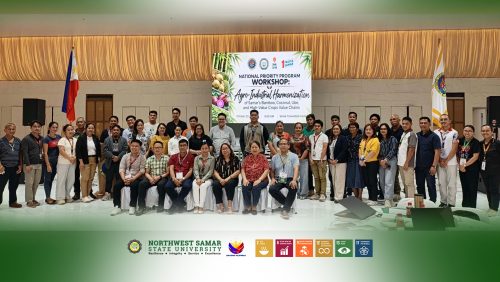
NwSSU facilitated the provincial workshop that grouped gaps in coconut, bamboo, ube and chili value chains into six convergence initiatives, including climate vulnerability of farmers.
2.5.3 – University access to local farmers and food producers
Our university is devoted to enhancing food security and promoting sustainable agriculture and aquaculture. We provide local
farmers and food producers with access to cutting-edge knowledge, skills, and technologies. Through targeted programs and
initiatives, we empower these key stakeholders to implement sustainable practices, improve productivity, and contribute to the
resilience of our local food systems.
– Newly Installed Rice Mill Unit to Benefit Hundreds of Agri Students and Farmers
Agricultural training facilities with the installation of newly upgraded rice mill unit, now fully operational for academic and research use.
Mrs. Charito C. Cabrera and her husband, Mr. Chrisanto Cabrera, served as the resource speakers during the three-day workshop. They shared their extensive expertise and patiently guided participants through every baking and food preparation step. Beyond technical skills, the couple also shared valuable tips, insights, and techniques drawn from their years of experience in bread and pastries, fostering a deeper understanding and appreciation for the art of baking. Their dynamic and approachable teaching style created an interactive and enjoyable learning environment, ensuring that all participants gained knowledge and confidence in their baking abilities.
2.5.4 – Sustainable food purchases
– NwSSU Sustainable Food Purchases
The university is dedicated to promoting sustainability through its procurement practices, adhering to the Philippine Green Public Procurement Roadmap as published by the Republic of the Philippines, Government Procurement Policy Board – Technical Support Office (GPPB-TSO). This roadmap guides our commitment to environmentally responsible purchasing.
According to Section 4.3.2 of the roadmap, which addresses the tendering of non-CSE (Common Supplies and Equipment) products with green core criteria, food and beverages procured by the university are required to be locally produced. This approach is designed to minimize transportation distances, reduce packaging
waste, and optimize storage efficiency. Prioritizing locally sourced food and beverages, we not only support local producers but also contribute to reducing our carbon footprint and promoting sustainable practices within our supply chain. This aligns with
our broader sustainability goals and underscores our commitment to environmental stewardship and responsible resource management.